Artificial intelligence has become an important part of digital marketing in 2026. From creating content and analyzing data to improving SEO, designing visuals, managing social media, and optimizing advertising campaigns, AI tools can help marketers work faster and make smarter decisions.
However, AI is not a replacement for marketing strategy or human creativity. The best results come when marketers use AI as a powerful assistant while maintaining their own expertise, brand voice, and understanding of customers.
Here are some AI tools and tool categories every digital marketer should know in 2026.
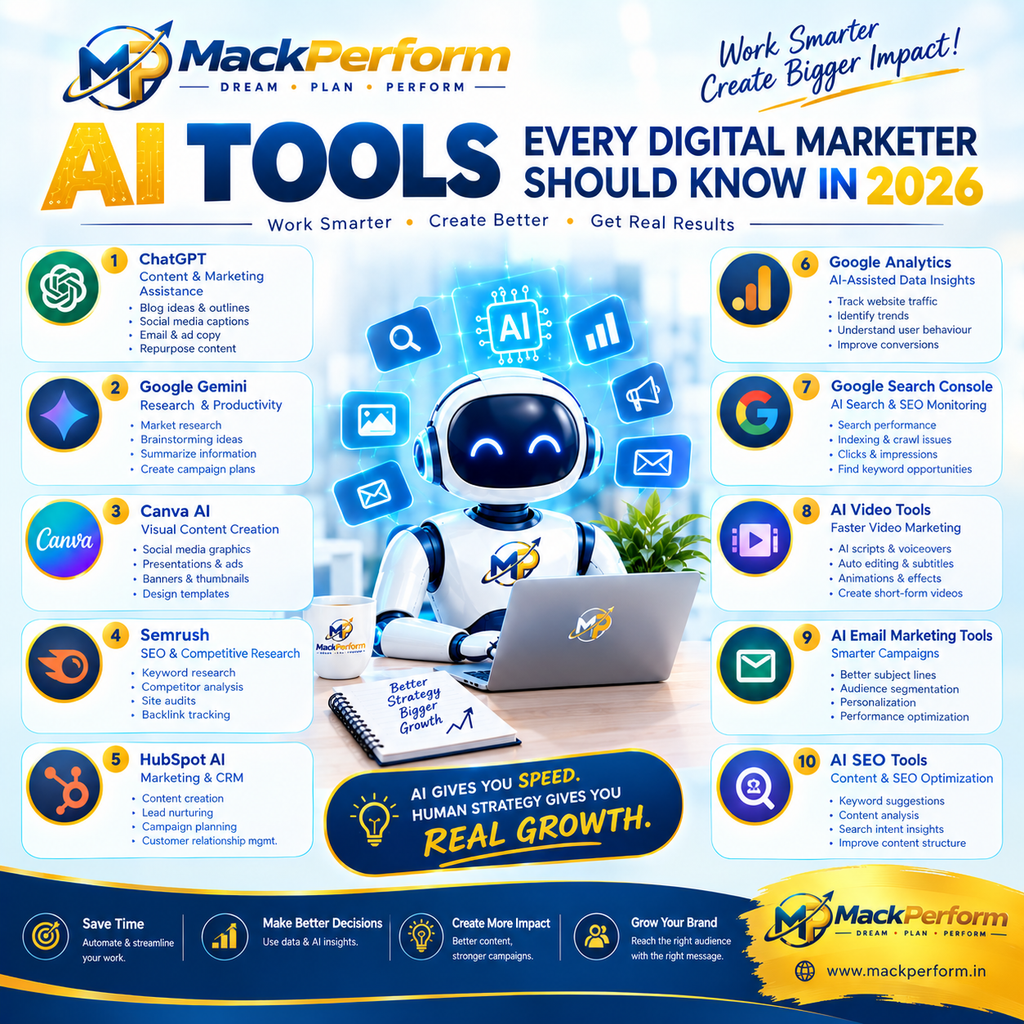
1. ChatGPT – Content and Marketing Assistance
ChatGPT can help digital marketers with brainstorming, content planning, blog outlines, social media captions, email ideas, ad copy, keyword research concepts, and customer FAQs.
Marketers can also use it to repurpose one piece of content into multiple formats. For example, a blog post can become social media posts, an email newsletter, a video script, and short-form content.
The important thing is to review AI-generated content and add your own expertise before publishing it.
2. Google Gemini – Research and Productivity
Google Gemini can support marketers with research, brainstorming, content creation, summarization, and productivity tasks.
Digital marketers can use AI assistants like Gemini to organize ideas, compare concepts, create campaign outlines, and analyze information. When using AI for research, marketers should always verify important facts and use reliable sources.
3. Canva AI – Visual Content Creation
Visual content is essential for modern digital marketing. Canva’s AI-powered features can help marketers create social media graphics, presentations, advertisements, banners, thumbnails, and other marketing materials.
For small businesses that may not have a dedicated graphic designer, AI-assisted design can make content creation faster and more accessible.
4. Semrush – SEO and Competitive Research
SEO requires research, monitoring, and continuous optimization. Semrush provides tools for keyword research, competitor analysis, site audits, backlink research, and SEO tracking.
AI-powered features can make it easier to discover content opportunities and organize SEO workflows. However, marketers still need to understand search intent and decide which opportunities are actually valuable for their audience.
5. HubSpot AI – Marketing and CRM
HubSpot combines marketing, sales, customer relationship management, and AI features in one platform.
Marketers can use AI-assisted features for content, customer communication, campaign planning, and productivity. This can be particularly useful for businesses that want to connect marketing activities with leads and customer relationships.
6. Google Analytics – AI-Assisted Data Insights
Understanding website performance is a major part of digital marketing. Google Analytics helps marketers measure traffic, engagement, conversions, and customer behaviour.
AI-assisted insights can help marketers identify unusual changes, trends, and opportunities in their data. Instead of looking only at how many visitors a website receives, marketers can focus on which channels and pages contribute to meaningful business results.
7. Google Search Console – AI Search and SEO Monitoring
Google Search Console is an essential tool for anyone managing SEO. It helps website owners understand search performance, indexing, queries, clicks, impressions, and technical issues.
As AI-powered search continues to evolve, marketers should continue monitoring how their websites perform in Google’s search ecosystem rather than relying only on traditional keyword rankings.
8. AI Video Tools – Faster Video Marketing
Video has become one of the most important content formats for digital marketers. AI video tools can assist with scripts, subtitles, editing, voiceovers, animations, and short-form video production.
These tools can reduce production time and help businesses create more consistent video content for platforms such as YouTube, Instagram, and other social channels.
9. AI Email Marketing Tools
AI can also help marketers improve email campaigns. AI-powered email platforms can assist with subject lines, content variations, audience segmentation, personalization, and campaign optimization.
Instead of sending exactly the same message to every subscriber, marketers can use customer data to create more relevant communication.
10. AI SEO and Content Optimization Tools
AI-powered SEO tools can help marketers analyze content, identify keyword opportunities, understand search intent, and improve content structure.
But marketers should avoid producing large amounts of low-quality AI content simply to target more keywords. Google’s guidance continues to emphasize helpful, original, people-first content.