
For small businesses, having a great product or service is only the beginning. Customers need to be able to find your business online when they are searching for solutions. Search Engine Optimization (SEO) helps improve your website’s visibility in search engines and can bring relevant visitors to your business without depending entirely on paid advertising.
In 2026, SEO continues to evolve with AI-powered search, changing customer behaviour, and increasingly visual search experiences. Here are 10 important SEO strategies every small business should follow.
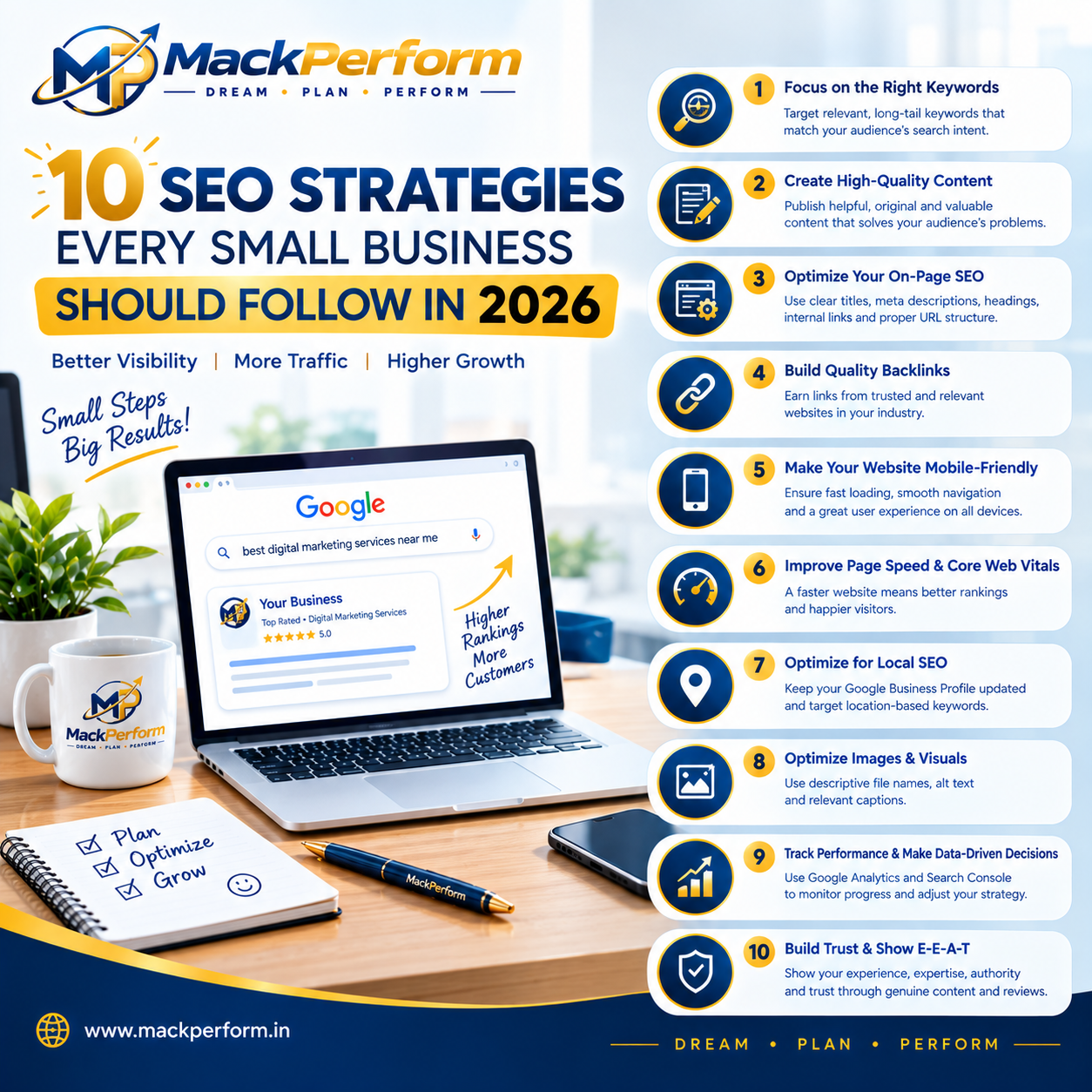
1. Focus on the Right Keywords
Start by understanding what your customers actually search for. Instead of targeting only broad keywords, consider specific and long-tail keywords that match customer intent.
For example, instead of targeting only “digital marketing,” a business could target “digital marketing services for small businesses.” The right keywords can help attract visitors who are more likely to become customers.
2. Create High-Quality Content
Content remains one of the most important parts of SEO. Create useful articles, guides, FAQs, case studies, and service pages that answer real customer questions.
Avoid creating content only to include keywords. Your content should provide genuine value, demonstrate expertise, and give readers a reason to trust your business.
3. Improve On-Page SEO
Every important website page should be properly optimized. Use descriptive page titles, relevant headings, useful meta descriptions, clean URLs, internal links, and naturally placed keywords.
Your content should also be easy to scan. Short paragraphs, bullet points, headings, and clear navigation can improve the experience for both visitors and search engines.
4. Build Quality Backlinks
Backlinks are links from other websites to your website. Links from trustworthy and relevant websites can help strengthen your site’s authority.
Small businesses can earn backlinks by publishing useful resources, contributing expert information, working with relevant industry websites, creating local partnerships, and producing original research or content worth referencing.
Focus on quality and relevance rather than simply collecting a large number of links.
5. Make Your Website Mobile-Friendly
Many customers use smartphones to search for businesses, products, and services. Your website should work smoothly across phones, tablets, and desktop computers.
Use responsive design, readable text, simple navigation, accessible buttons, and properly sized images. A visitor should be able to find information and contact your business easily from any device.
6. Improve Page Speed and Core Web Vitals
A slow website can create a poor user experience. Optimize large images, reduce unnecessary scripts, use efficient hosting, and keep your website technically healthy.
Google’s Core Web Vitals focus on aspects of loading performance, responsiveness, and visual stability. Improving these areas can contribute to a better experience for your visitors.
7. Optimize for Local SEO
Local SEO is especially important for businesses that serve specific locations.
Keep your Google Business Profile accurate and complete. Make sure your business name, address, phone number, website, services, and opening hours are correct.
Encourage genuine customer reviews and create useful location-specific content when it is relevant to your business.
8. Optimize Images and Visual Content
Search is becoming increasingly visual. Don’t ignore images when optimizing your website.
Use descriptive image filenames, relevant alt text, appropriate image sizes, and high-quality original visuals. Images should support the content rather than simply decorate the page.
For businesses such as MackPerform, professional graphics, service visuals, infographics, and videos can also make website content more engaging.
9. Track Performance and Make Data-Driven Decisions
SEO should not be based on guesswork. Use tools such as Google Search Console and Google Analytics to understand how visitors discover and interact with your website.
Monitor search queries, impressions, clicks, traffic, engagement, conversions, and important landing pages. Use these insights to identify what is working and where improvements are needed.
10. Build Trust and Demonstrate E-E-A-T
Trust is essential for a successful online presence. Google discusses E-E-A-T: Experience, Expertise, Authoritativeness, and Trustworthiness as an important framework for thinking about content quality.
Show your experience through useful content, real examples, case studies, customer reviews, author information, business details, and transparent contact information.