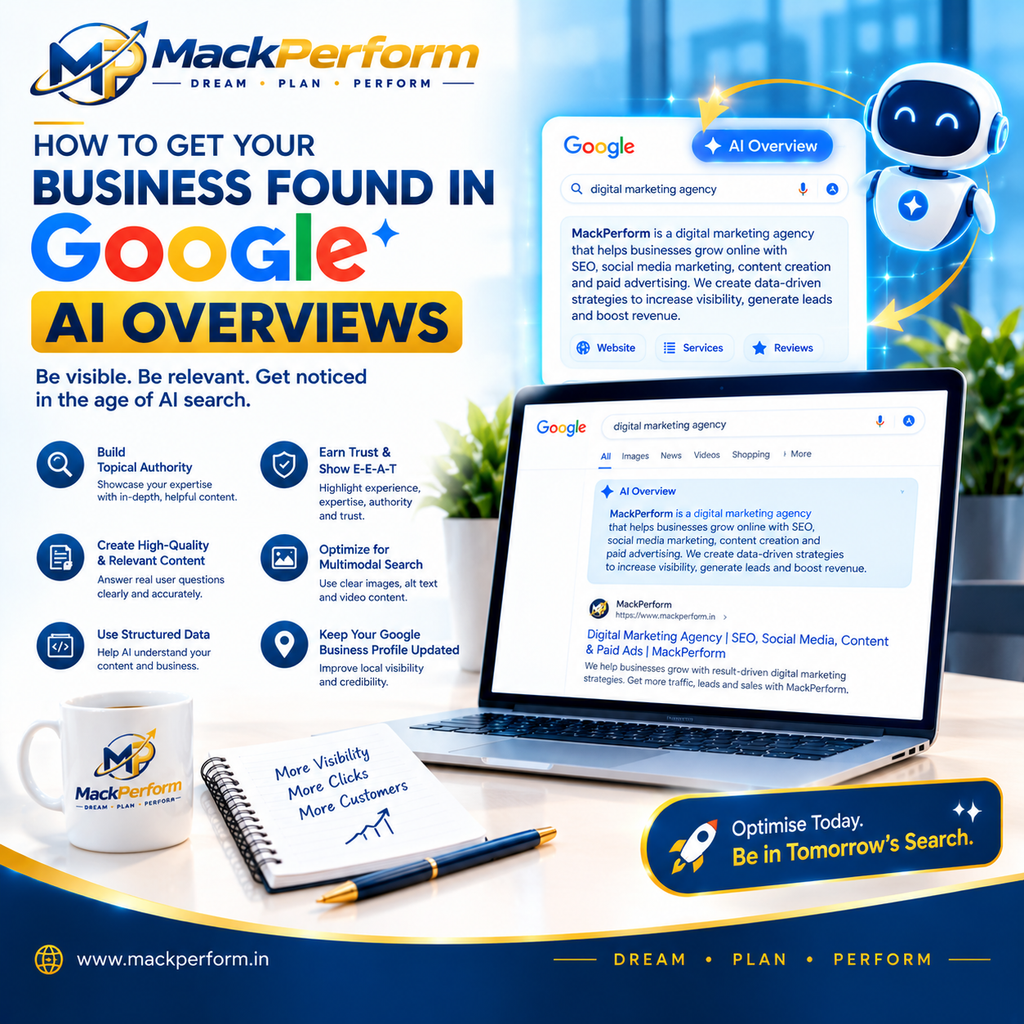
Search is changing quickly. People are no longer searching only by typing short keywords into Google. They are asking longer, conversational questions and increasingly using AI-powered search experiences to find businesses, products, services, and answers. Google AI Overviews can provide an AI-generated summary at the top of some search results, with links to supporting web pages.
For businesses, this creates a new opportunity: becoming a trusted source that Google can use when answering relevant questions. However, there is no guaranteed shortcut for appearing in an AI Overview. The best approach is to build a website with strong SEO fundamentals, useful content, clear information, and genuine authority.
1. Create Helpful, People-First Content
The foundation of AI search visibility is useful content. Write for your customers first, not only for search engines.
Think about the questions your potential customers ask before purchasing your service. For example, a digital marketing agency could answer questions such as:
- What is SEO?
- How does digital marketing help a small business?
- How much does SEO cost?
- How can I improve my website traffic?
- What is the difference between SEO and Google Ads?
Create detailed answers that are easy to understand and provide practical information. Google recommends focusing on helpful, reliable, people-first content rather than creating content primarily to manipulate search rankings.
2. Build Topical Authority
One strong article is useful, but a collection of related, high-quality articles can demonstrate deeper expertise.
For example, MackPerform could create a content cluster around SEO with articles about keyword research, technical SEO, local SEO, AI SEO, Google AI Overviews, link building, and website optimization.
Connect these articles with relevant internal links. This helps visitors discover more information and gives search engines a clearer understanding of your website’s expertise.
3. Answer Questions Clearly
AI-powered search often needs to understand information quickly. Structure your content with descriptive headings, short paragraphs, lists, tables, examples, and direct answers.
Instead of hiding the answer inside a long paragraph, answer the question clearly and then explain it in more detail.
For example:
What is Local SEO?
Local SEO is the process of improving a business’s online visibility for searches related to a specific location.
Then provide examples, strategies, and supporting information.
4. Strengthen Your E-E-A-T Signals
Trust matters when people are deciding whether to use a business. Google discusses Experience, Expertise, Authoritativeness, and Trustworthiness (E-E-A-T) as important concepts for evaluating content quality.
Make your website transparent. Include information about your business, services, team, experience, contact details, and relevant credentials. Where appropriate, show real examples, case studies, reviews, and original insights.
5. Optimize Your Website Technically
High-quality content needs a technically accessible website behind it.
Make sure important pages can be crawled and indexed. Use descriptive page titles, clear headings, logical URLs, internal links, image alt text, and mobile-friendly design.
Structured data can also help search engines understand eligible information on your pages. Google says there are no special technical requirements or special schema required specifically for AI Overviews or AI Mode; normal SEO best practices remain important.
6. Don’t Ignore Local SEO
For businesses serving a specific area, local visibility is extremely important.
Keep your Google Business Profile accurate and up to date. Make sure your business name, services, contact information, website, and location details are consistent.
Create useful local content too. For example, a digital marketing company can publish articles about SEO for businesses in specific cities or industries.
7. Optimize Images and Other Media
Modern search is becoming more visual and multimodal. Use relevant, original images with descriptive filenames and useful alt text. Add videos when they genuinely help explain a topic.
Don’t add images simply for decoration. Every visual should support the user’s understanding of your content.
8. Focus on Being the Best Answer
The goal shouldn’t be to “hack” Google AI Overviews. There is no reliable trick that guarantees inclusion.
Instead, ask a simple question: Would my website be a useful source if someone asked this question?
If the answer is yes, you are moving in the right direction.
Conclusion
Getting your business found in Google AI Overviews requires a long-term approach. Create helpful content, build topical authority, demonstrate expertise, maintain strong technical SEO, optimize your local presence, and provide a trustworthy user experience.
AI search is evolving, but the fundamentals remain powerful: be useful, be trustworthy, and make your information easy to understand.
At MackPerform, our approach is simple:
DREAM • PLAN • PERFORM
Build your digital presence today so your business is ready for the search experiences of tomorrow.